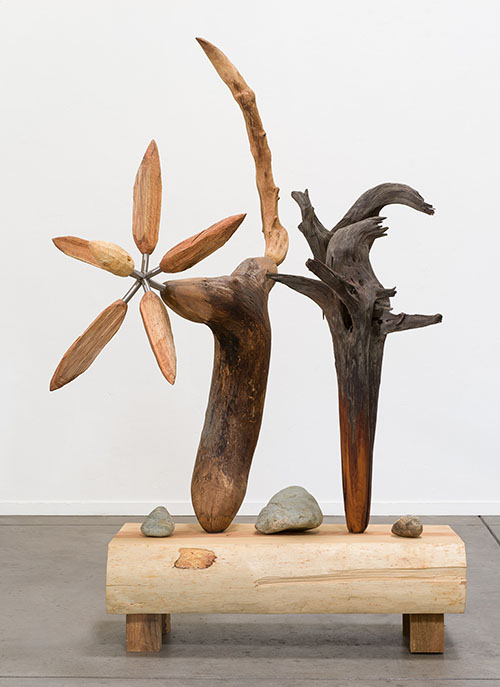
Although he makes use of the Surrealist’s exploration of the unconscious—the dream, the nightmare and erotic fantasy—he also touches base with the fundamental Modernist movements, seizing and transforming their planar organization of form and abstract language. He then mixes elements from American primitive images and folk art, as well as animistic totems of the Dogon and Inuit. Admittedly, Surls has been moved by the spiritual urgency of William Blake, the British Romanticist whose visions were the source of his poems and drawings. Throughout the decades, critics have noted the influence of Alexander Calder in the facility with line and deeply immersed visions of the cosmos; Giacometti in his metaphoric and hybrid personages that straddle the human and animal or exist in conditions of becoming. Louise Bourgeois’s visceral intuitive art that often functions on animistic levels seems relevant, so is Yayoi Kusama’s use of dot and circle intensive art that reconnects with the visionary. There are echoes, as well, in the blacksmith’s persistence of David Smith to temper steel with a kind of ductile irony.
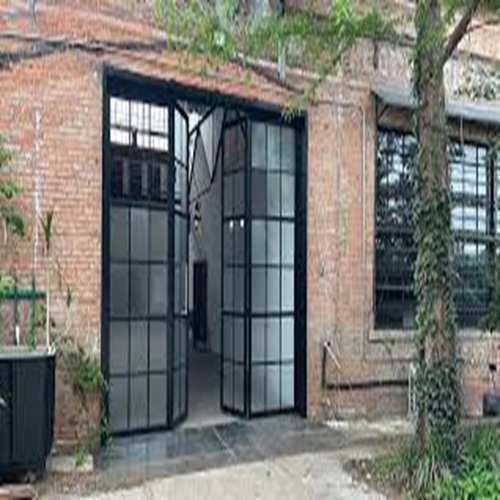
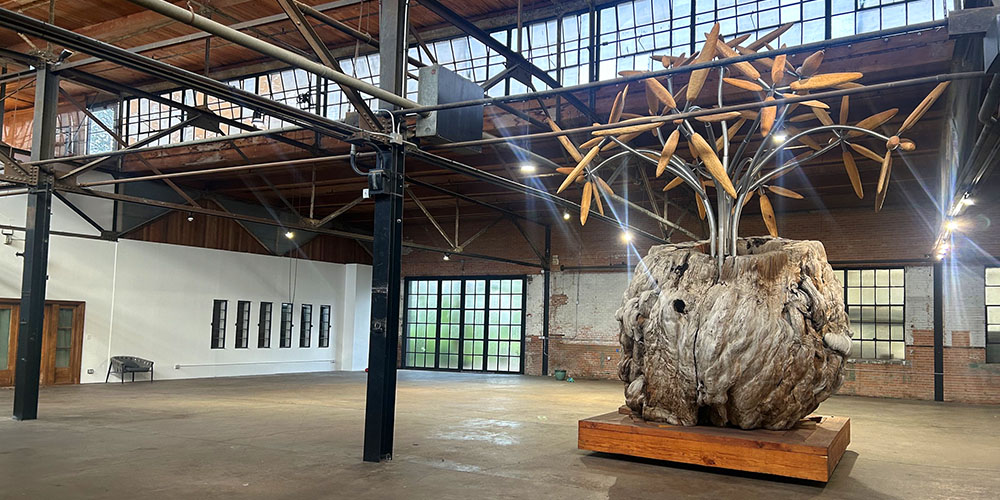
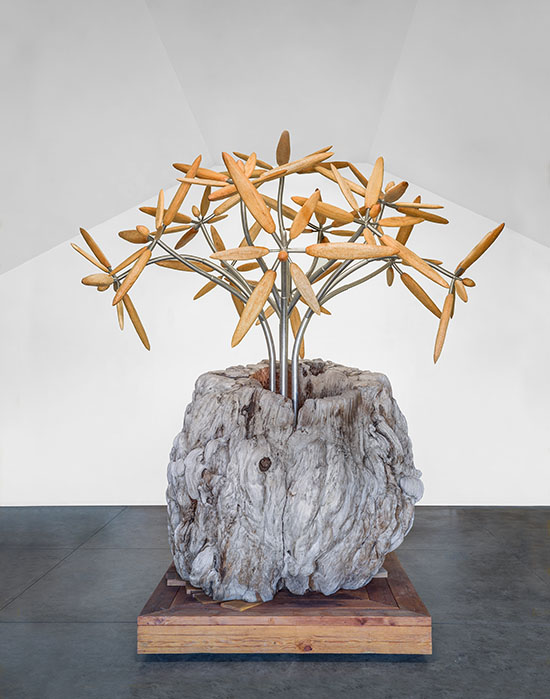
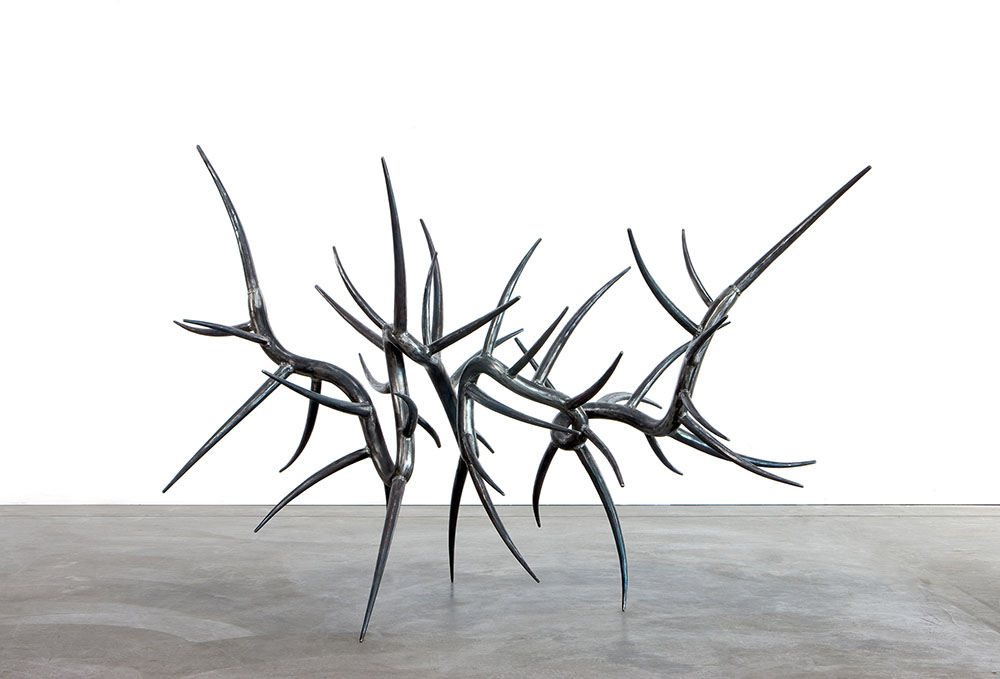
As we walk through the 15 foot doors of Passage Arts, there’s an eerie sensation of being drawn into the fires. Stepping into From the Old Growth is to feel a kinship with ancient working rhythms, with totem builders of early primitive societies, with ancestral memories from deep time. In that instant, we enter a gateway initiated into the world as it is, a crosscurrent of emerging patterns and shadows, a world that changes and transforms us in the moment of contact. To traverse Surls’s sculptures in this environment is to sense a reflex we may not have felt so clearly before—skin, pull, sensuousness, illusion. We approach the colossal From the Old Growth (2022) as a paean to nature’s forces, taking in its crevices like gulps of air after escaping a miasma. The suspended sculptures, Walking with Diamonds (1995) and She is With the Diamond (1995) show Surls to have chiseled pine, oak and magnolia into a pair of “figures” more powerful than any mythical beasts. Suggesting the truncated bodies of muscular animals that lunge, twist and recoil, they stretch out their legs in a graceful and terrible dance. Their feet—carved knife blades—are as sharp as ice picks. To walk around these pieces is to sense insecurity, danger, peril. They are shapeshifters, seething with an almost feral desire. At times, the sculptures become charged fields of their own energies, and when they meet, they give off brilliant sparks. The striding “legs” and flailing “tentacles” of the steel floor sculpture, Rough God 5 (2010) seemingly propel themselves toward us. Surls’s fluid gestures unfurl areas of serpentine circuitry and sinew of monstrous tumor formations in the process of unbridled growth. The effect is both menacing and beckoning. We see it as a living organism that exists in our own environment and relies on the same air, earth and water for survival.
Surls doesn’t aim for a comforting sort of art, nor does he believe in the art object as one of passive contemplation. Rather, he intends the work to be a provocation, a kind of shock treatment that jolts viewers into an examination of their own values and behaviors. All of the suspended and free-standing sculptures in From the Old Growth tend to be prickly, abrasive and confrontational. They move us with the rawness of their exposure, the brute images of human life experienced close to the bone.
In the cavernous space of Passage Arts, the sculptures speak to us intimately, as if they were rendered from a great depth in the artist himself. At 83 years, a vibrating, unstable identity shimmers into Surls’s being. For that reason, From the Old Growth is the most important exhibition of his six decade career, compelling us to recognize that what matters is not just what we see but what pulls us close and why, what private histories we bring to the encounter, what expectations and tools. At Passage Arts, Surls takes us on a journey bound for redemption or ecstasy—a twining path driven by wind and weather, necessity and circumstance, but never straying far from its origin stories.
Toward that end, From the Old Growth firmly establishes Surls’s legacy as a prophetic visionary and iconic American artist while also staking the kind of experiential relevance hungered by a new generation of viewers. Surls possesses that relentless force, drilling deep over a lifetime. In this increasingly risk averse and uncertain climate, an installation of such magnitude is not likely to be undertaken by a mainstream museum. The entire gathering feels especially resonant in the spiritual atmosphere of our current era, where every human endeavor is translated into ratings, clickbait and luxury branding, forces that push away from the capacity to move us, sensitize us and produce new forms of ideas and emotions. From the Old Growth brings us back to a sturdy core where creativity is unpredictable, uncontrollable, and incessantly passionate.